
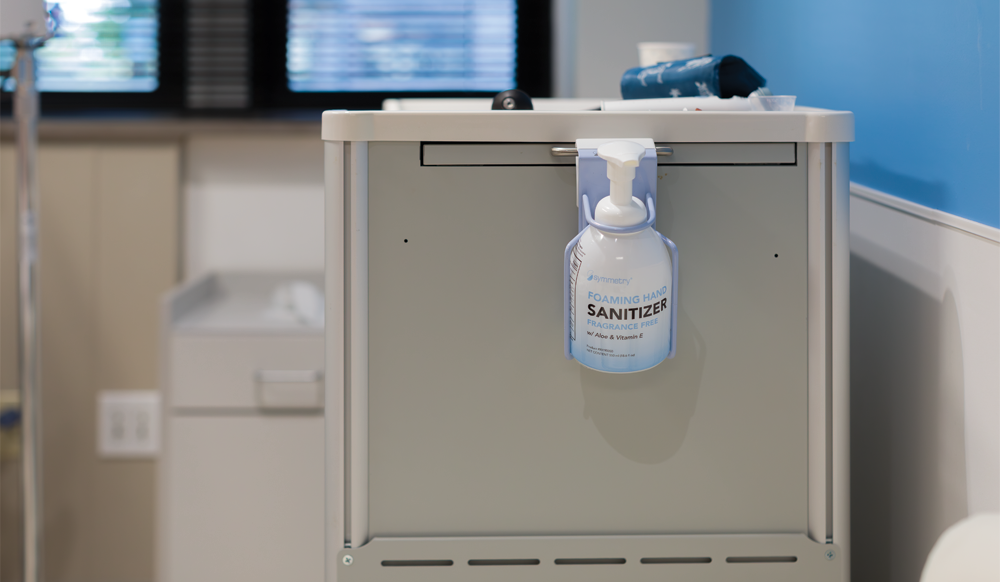
Most healthcare workers already know when they should clean their hands. So why does compliance so often fall short? Usually it's not a knowledge gap — it's an access gap. If a dispenser is down the hall, a busy provider moving between patients is far less likely to use it. Making hand hygiene tools available exactly where care happens is one of the simplest, most overlooked ways to close that gap.
Why Hand Hygiene Matters
Hand hygiene is the single most effective way to prevent healthcare-associated infections (HAIs). HAIs are linked to prolonged hospital stays, long-term disability, antimicrobial resistance, poor outcomes, added costs, and unnecessary deaths. The connection to compliance shows up clearly in the data: a multi-year study in Finland tracking over 52,000 observations found that as annual compliance rose from 76.4% in 2013 to 88.5% in 2018, HAIs fell from 2,012 cases to 1,831 over the same period. Yet compliance remains inconsistent—one Tunisian study found compliance improved from 21% to 40% over four years, still short of WHO's 80% target even after training. Knowledge alone doesn't close that gap—access does.
The 5 Moments for Hand Hygiene
The WHO's "5 Moments" framework defines exactly when hand hygiene is needed during patient care:
1. Before Patient Contact
2. Before an Aseptic Task
3. After a Body Fluid Exposure Risk
4. After Patient Contact
5. After Contact with Patient Surroundings
These moments mark the points where transmission risk is highest, which is why *where* the product sits matters as much as knowing the rule. One large study found compliance was weakest at Moment 1, with rates around 55.8% versus 79.1% for Moment 5—the exact moment a provider is entering a room and may not have a dispenser at hand.
Closing the Gap: Point of Care Access
"Point of care" refers to the moments a provider is in direct contact with a patient or their environment. Putting hand hygiene products in that exact zone, rather than requiring a walk to a wall-mounted station, removes the biggest barrier to compliance: convenience. As Dr. William Parks, CMO of Memorial Hermann the Woodlands, put it, “If a product isn't convenient in the moment, staff won't go out of their way to find it.”
The APIC Implementation Guide frames the goal well: hand hygiene should be available in the "patient zone" — where the patient, provider, and environment intersect. That zone includes the hospital's most contaminated high-touch surfaces: bedrails, bed surfaces, supply carts, over-bed tables, and IV pumps.
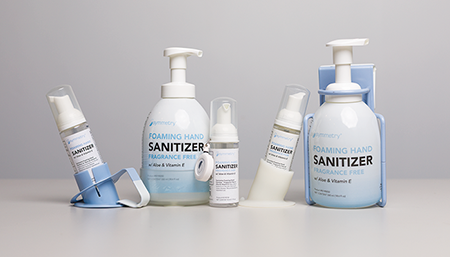
How Symmetry Point of Care Tools Support the 5 Moments
Symmetry's Point of Care line puts sanitizer within arm's reach at exactly these moments:
- 50 ml Tray Table / W.O.W. Clip — attaches to a workstation-on-wheels, traveling with the provider room to room
- 50 ml / 550 ml Suction Cup — mounts near the bedside without permanent installation
- 550 ml Wire Bracket — fixed placement in a patient room or care area
- 550 ml Anesthesia Cart Bracket — built for procedural/surgical settings
- 50 ml Lanyard — worn by the provider, so sanitizer is always on hand
A lanyard or clip supports Moment 1 by traveling with the provider into every room. Bedside mounts support Moments 2 and 3, keeping sanitizer ready before an aseptic task or after a fluid exposure risk. And because these tools live in the patient zone, they also reinforce Moments 4 and 5 as the provider leaves.
The Bottom Line
Hand hygiene compliance is less an education problem than a design problem. The 5 Moments tell providers when hygiene matters most; point of care tools make it realistic to act on that knowledge consistently, patient after patient.
Contact your representative to learn more about how Symmetry Point of Care Tools can improve compliance in your healthcare facility.
 CONTACT US